
What does the prefix mis imply – What does the prefix “mis-” imply? This basic query unlocks a captivating world of linguistic nuance. Understanding how “mis-” transforms phrases is not simply a tutorial train; it is a key to deciphering on a regular basis language, greedy delicate variations in which means, and even appreciating the historic evolution of our vocabulary.
Delving into the prefix “mis-” reveals its impression on phrase which means, from delicate shifts in connotation to outright reversals. We’ll discover its origins, evolution, and purposes throughout varied contexts, highlighting how this seemingly easy prefix shapes our communication.
Defining “mis-“
The prefix “mis-” is a ubiquitous factor within the English language, subtly altering the which means of phrases. Its software is extra than simply including a damaging connotation; it typically signifies an error, a failure, or a deviation from the meant which means. Understanding the nuances of this prefix is essential for efficient communication and comprehension.The prefix “mis-” sometimes introduces a way of error, incorrectness, or failure to the foundation phrase.
This modification in which means can vary from a easy mistake to a extra vital drawback or an entire reversal of the meant motion. As an illustration, “perceive” turns into “misunderstand” indicating a failure to understand accurately. This semantic shift is a key factor of the prefix’s perform.
Semantic Shift and Modification
The prefix “mis-” operates by essentially altering the meant which means of the foundation phrase. It typically implies a failure to attain the specified consequence, an incorrect efficiency of the motion, or a deviation from the anticipated normal. This modification might be delicate, as in “interpret” versus “misread,” or dramatic, as in “spell” versus “misspell.”
Examples of “mis-” in Motion
A spread of phrases make use of the prefix “mis-,” demonstrating its versatility and impression on which means.
Understanding the prefix “mis” is essential for deciphering many phrases, typically tripping up spellers. It signifies an error, a mistake, or a incorrect motion. This typically results in phrases which are surprisingly troublesome to spell, like “misread” or “misjudge,” as demonstrated within the record of words difficult to spell. In the end, understanding the prefix “mis” offers a key to accurately deciphering and utilizing these advanced phrases.
- Miscalculate: To calculate incorrectly.
- Misplace: To place one thing within the incorrect place.
- Misunderstand: To fail to know one thing accurately.
- Misread: To interpret one thing incorrectly.
- Mismanage: To handle one thing poorly.
These examples illustrate how the prefix “mis-” transforms the unique which means of the foundation phrase, typically introducing a component of error or failure.
Comparative Evaluation
The next desk highlights the distinction in which means between phrases with and with out the prefix “mis-“:
| Phrase | That means | Phrase with “mis-“ | That means |
|---|---|---|---|
| Interpret | To clarify the which means of one thing | Misread | To clarify the which means of one thing incorrectly |
| Spell | To write down the letters of a phrase | Misspell | To write down the letters of a phrase incorrectly |
| Use | To make use of one thing | Misuse | To make use of one thing incorrectly or improperly |
| Lead | To information or direct | Mislead | To information or direct somebody incorrectly or deceptively |
| Choose | To type an opinion or decide | Misjudge | To type an opinion or decide incorrectly |
This comparability clearly demonstrates the semantic shift that happens when the prefix “mis-” is added to the foundation phrase, reworking a impartial motion into one characterised by error or failure.
Examples and Functions

The prefix “mis-” is a robust instrument within the English language, drastically altering the which means of a phrase. Understanding its nuances is essential for efficient communication and comprehension. This part delves into the sensible purposes of “mis-” throughout varied contexts, from formal grammar to on a regular basis speech.The prefix “mis-” persistently denotes error, failure, or incorrectness. It essentially negates or reverses the meant which means of the foundation phrase.
This delicate shift in which means can considerably impression the interpretation of a sentence, shaping the reader’s or listener’s understanding of the state of affairs. This impression might be essential in fields starting from authorized paperwork to advertising copy.
Sensible Functions of “Mis-“
This part demonstrates the flexibility of the prefix “mis-” in various contexts, highlighting its delicate but impactful function in modifying which means. Understanding these purposes will improve your means to understand and make the most of the prefix precisely.
Examples of “Mis-” in Phrases
A deeper understanding of the prefix “mis-” is achieved by way of analyzing its software in varied phrases. The next record demonstrates this impression:
- Misread: To wrongly perceive or construe one thing.
- Misplace: To place one thing within the incorrect place.
- Misspell: To write down a phrase incorrectly.
- Mismanage: To deal with one thing poorly or ineffectively.
- Misunderstand: To fail to understand one thing accurately.
- Misinform: To supply false or deceptive data.
- Miscalculate: To make a incorrect calculation.
- Mislead: To deceive or trigger somebody to consider one thing false.
- Misquote: To cite one thing inaccurately.
- Misjudge: To type an incorrect opinion or analysis of one thing or somebody.
These examples illustrate how “mis-” creates a direct distinction to the bottom phrase, implying a damaging or faulty consequence. The delicate shift in which means might be essential in conveying particular nuances.
The prefix “mis” typically signifies a damaging connotation or error. Take into consideration how “misread” suggests a incorrect understanding, or “misplace” signifies a incorrect place. Within the context of extraordinary achievements, recognizing somebody as “you the actual MVP” ( you the real mvp ) highlights a optimistic motion, not a mistake. This optimistic motion is the other of a “mis” prefix which means.
In the end, understanding “mis” is about recognizing the distinction between errors and distinctive outcomes.
Sentence Examples
The next sentences display how “mis-” alters the which means of a sentence:
- “He misinterpreted the directions, resulting in a expensive error.” The sentence illustrates how “misinterpreting” directions can lead to damaging penalties.
- “She misplaced her keys, inflicting her to be late for the assembly.” The sentence demonstrates how misplacing one thing can lead to delays and disruptions.
- “The coed misspelled a number of phrases on the examination, impacting his rating.” This illustrates how a easy misspelling can have an effect on a ultimate consequence.
These examples spotlight the prefix’s means to shift the which means from a optimistic or impartial motion to a damaging or faulty one.
Understanding the prefix “mis” is essential for deciphering many phrases, typically tripping up spellers. It signifies an error, a mistake, or a incorrect motion. This typically results in phrases which are surprisingly troublesome to spell, like “misread” or “misjudge,” as demonstrated within the record of words difficult to spell. In the end, understanding the prefix “mis” offers a key to accurately deciphering and utilizing these advanced phrases.
Affect of “Mis-” on That means
This movement chart illustrates the alternative ways the prefix “mis-” alters the which means of a phrase:  The flowchart visually represents the impression of the prefix. The enter is the bottom phrase, and the prefix adjustments its which means to its reverse or a defective type.
Synonyms for Phrases with “Mis-“, What does the prefix mis imply
Understanding synonyms for phrases with “mis-” can enrich your vocabulary and permit for a extra nuanced expression of concepts. The next examples spotlight delicate variations in which means:
| Phrase with “Mis-“ | Synonym | That means Distinction |
|---|---|---|
| Misread | Erroneously interpret, misconstrue | Whereas all recommend a misunderstanding, “erroneously interpret” focuses on the inaccuracy of the interpretation, and “misconstrue” emphasizes a deliberate misinterpretation. |
| Misplace | Lose, mislay | “Lose” suggests the merchandise is gone solely, whereas “mislay” implies it’s quickly misplaced. |
| Mismanage | Poorly handle, mishandle | “Poorly handle” emphasizes the dearth of talent, whereas “mishandle” suggests a careless or negligent method. |
These delicate variations in synonyms display the richness and complexity of the English language, permitting for exact communication.
Historic Context and Evolution
The prefix “mis-” holds a captivating place within the historical past of language, reflecting not solely the evolution of which means but in addition societal shifts and mental improvement. Understanding its historic trajectory reveals how our understanding of errors, errors, and misguided actions has remodeled over time. This journey traces the prefix’s origins, its altering purposes throughout completely different fields, and its impression on language as a complete.The prefix “mis-” signifies a deviation from the meant or anticipated path, a departure from the norm.
This inherent idea of error, or the “reverse” of the meant which means, has roots in historic linguistic buildings. Tracing its historic evolution offers insights into how our perceptions of errors have modified. The prefix’s adaptability throughout languages and disciplines offers a captivating glimpse into how this single prefix has developed over time.
Understanding the prefix “mis” is essential for deciphering many phrases, typically tripping up spellers. It signifies an error, a mistake, or a incorrect motion. This typically results in phrases which are surprisingly troublesome to spell, like “misread” or “misjudge,” as demonstrated within the record of words difficult to spell. In the end, understanding the prefix “mis” offers a key to accurately deciphering and utilizing these advanced phrases.
Origins of the Prefix
The prefix “mis-” seemingly originated from Proto-Indo-European roots, signifying a damaging or reverse idea. These roots are the inspiration for quite a few phrases in varied fashionable languages, highlighting the enduring affect of those historic linguistic buildings. The precise etymology stays considerably obscure, however its presence in various languages suggests an extended historical past. Early examples of phrases containing “mis-” are present in varied historic texts, providing a glimpse into the conceptual framework of these civilizations.
Evolution of That means Over Time
The which means of “mis-” has not remained static. Early utilization typically centered on bodily deviations or errors, like “mis-aiming” or “mis-stepping.” Over time, the scope broadened to embody conceptual errors, social misjudgments, and ethical transgressions. This growth mirrors the rising complexity of human thought and social interplay. The prefix’s means to adapt displays the dynamic nature of language itself.
Cross-Linguistic Comparability
Whereas the precise etymology might differ throughout languages, the core idea of “mis-“—a deviation from the meant which means—stays remarkably constant. Comparisons throughout languages, together with however not restricted to Germanic, Romance, and Slavic languages, reveal comparable patterns of utilization and which means evolution. As an illustration, the idea of “misunderstanding” is current in varied languages, reflecting a common human expertise. Detailed evaluation of linguistic patterns can reveal fascinating insights into the evolution of the prefix throughout completely different linguistic households.
Evolution in Numerous Fields
The prefix “mis-” has impacted various fields of research. Within the realm of science, “mis-calculation” highlights the significance of accuracy. In regulation, “mis-representation” emphasizes the significance of truthfulness. The prefix’s presence in these areas underscores its relevance in navigating the complexities of human endeavor. Its adaptability throughout these fields displays the common want for accuracy and correctness.
This means to adapt to completely different fields highlights the significance of language in shaping our understanding of the world.
The prefix “mis” typically signifies a incorrect or incorrect motion or state. Understanding this helps decipher many phrases, however contemplate the fascinating relationship to three-letter phrases containing the letter “x” like “combine,” “max,” and “wax.” This juxtaposition highlights how seemingly disparate linguistic parts can reveal patterns. In the end, understanding the prefix “mis” deepens our grasp of language. 3 letter words containing x are a very good instance of how such linguistic evaluation works.
Timeline of “Mis-” Evolution
Sadly, making a exact timeline for the evolution of the prefix “mis-” is troublesome because of the restricted availability of detailed historic information. Nonetheless, tracing its presence in historic texts, non secular scriptures, and historic paperwork permits for some estimation. A rudimentary timeline might embody durations when “mis-” turned extra prevalent in particular fields, like philosophy or regulation, primarily based on the surviving literature and proof.
Final Recap
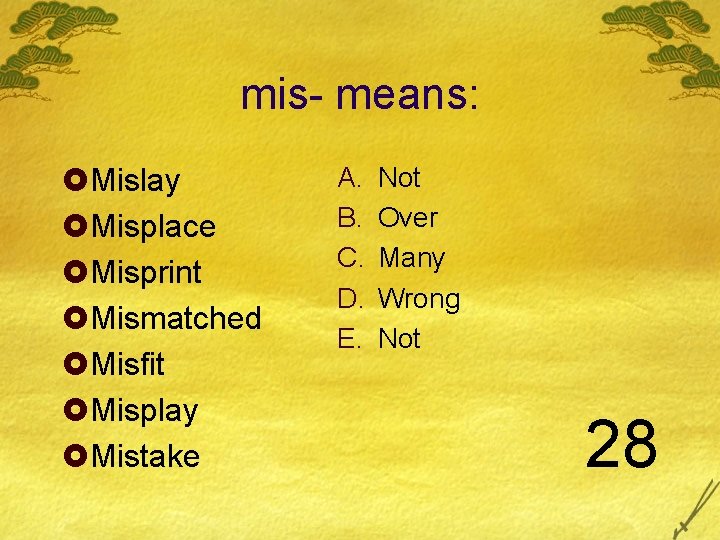
In conclusion, the prefix “mis-” is greater than only a syllable tacked onto a phrase; it is a highly effective instrument for modifying which means. Its historic journey, diversified purposes, and delicate semantic shifts underscore its significance in understanding the intricacies of language. This exploration of “mis-” empowers us to research phrases with larger precision and recognize the richness of the English language.
Useful Solutions: What Does The Prefix Mis Imply
What are some widespread misspellings of phrases containing the prefix “mis-“?
Whereas in a roundabout way associated to the prefix’s which means, recognizing widespread misspellings of phrases with “mis-” can enhance comprehension and accuracy. As an illustration, “mispell” is wrong; the right spelling is “misspelled”.
How does the prefix “mis-” differ from different prefixes like “un-” or “in-“?
“Un-” and “in-” typically negate or reverse a phrase’s which means, whereas “mis-” typically implies error, failure, or a incorrect path. Understanding these delicate variations is essential for correct interpretation.
Can the prefix “mis-” be used with all elements of speech?
Sure, the prefix “mis-” can modify nouns, verbs, adjectives, and adverbs, demonstrating its versatility within the English language.
Are there any cases the place “mis-” is used figuratively?
Sure, the prefix can be utilized metaphorically to point a flawed method or a mistaken judgment in summary contexts.
